

2021 Asia Intervention - Mgmt Strategies for STEMI in LMICs - experience of the TN STEMI programme
Management strategies for acute STEMI in low- and middleincome countries: experience of the Tamil Nadu ST-segment elevation myocardial infarction programme

2019 Annals of Global Health - Economic and Societal Impact of a Systems-of-Care Approach
Economic and Societal Impact of a Systems-of-Care Approach for STEMI Management in Low and Middle-Income Countries: Insights from the TN STEMI Program

2017 JAMA - A System of Care for Patients with STEMI in India
Economic and Societal Impact of a Systems-of-Care Approach for STEMI Management in Low and Middle-Income Countries: Insights from the TN STEMI Program
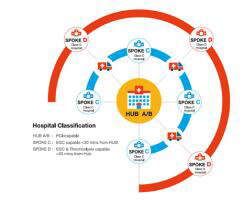
STEMI Protocol to Improve Access to PCI for STEMI in Low- and Middle-Income Countries
An innovative model of a STEMI system of care could be an important tool for improving survival in countries such as India that have limited healthcare infrastructure, widespread poverty, and poor accessibility to emergency medical services (EMS). ...

Heart disease fast catching up with young Indians: Experts
Heart disease has affected the young Indian population 10 years ahead of their Western counterparts -- particularly over the last three decades -- owing to sedentary lifestyles and lack of exercise, the nations top cardiologists have warned. Heart disease or cardiovascular disease (CVD) is a collective term for diseases of the heart and blood vessels. The term commonly includes diseases such as coronary heart disease, heart failure, cardiomyopathy, congenital heart disease, peripheral vascular disease and stroke. ...
Health agency recommends nationwide adoption of hub-and-spoke network
New Delhi, March 8: India's health research agency has recommended the nationwide adoption of a heart attack treatment protocol that doctors say is intended to benefit tens of thousands of patients across the country currently unable to access timely care....
Health agency recommends nationwide adoption of Hub and Spoke network
The Indian Council of Medical Research (ICMR) has urged states with existing ambulance networks to implement the protocol that relies on a hub-and-spoke network of large and small hospitals and ambulances equipped to exchange electrocardiograph (ECG) readings via mobile devices....
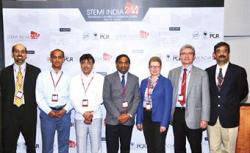
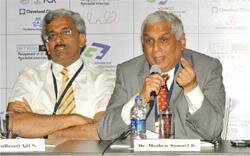
The 2-day STEMI conference majorly seeks to train and equip each hospital in Western India to take appropriate care of heart attack patients within the golden hour
With more than three million heart attacks happening every year in India, STEMI India 2014 in collaboration with Stent for Life, the joint EAPCI and EuroPCR Initiative is organising a two-day conference at The Renaissance Mumbai Convention Centre, from 31st May to June 1, 2014. The conference will address designing of high reliability systems which would measure quality of care in hospitals in Western India (Maharashtra, Goa, Gujarat, Madhya Pradesh) in areas of therapeutic procedures, medications and treating of acute myocardial infarction (heart attack). The course directors of STEMI India 2014, Dr. Thomas Alexander, Head of Division of Cardiology, Kovai Medical Cent...

New heart disease treatment protocol improves angiography; lowers mortality
An Indo-US team of medical specialists has perfected a new heart disease treatment protocol that has the potential to save lives of thousands of Indians requiring timely medical care following a heart attack....
Need a title for this
Imagine how many lives could be saved if the time taken for a person with some manner of heart attack to reach the hospital comes down from six hours to just under three hours. And that's exactly what STEMI (ST Elevation Myocardial Infarction) India is aiming to do as they expand their life-saving model to four large hospitals across Tamil Nadu. With three million Indians having cardiac issues every year, a 'huge' number of lives hang in balance. STEMI India, a project that began two years ago to try and reduce deaths caused due to myocardial infarctions, will now expand their pilot project from one hospital to four major cardiac centres ...

A System of Care for Patients With ST-Segment Elevation Myocardial Infarction in India
Importance Challenges to improving ST-segment elevation myocardial infarction (STEMI) care are formidable in low- to middle-income countries because of several system-level factors...

STEMI India and Stent for Life join forces
The STEMI India and ACT 2013 meeting (www.stemiact13.com) will be held in collaboration with the Stent for Life Initiative from 12-14 July 2013 at Chennai, India. This day and a half programme will provide a comprehensive review and training to the medical team involved in the processes and procedures in the care of the STEMI patient – from the emergency room physician, intensivist and nurses in CCU, to the clinical cardiologist involved in thrombolysis and to the cardiac catheterisation laboratory team in PCI capable hospitals. The primary aim of the meeting is to develop "STEMI Teams" in hospitals capable of quickly and appropriately managing STEMI patients thereby re...

A recent paper published in the British Heart Journal highlights the need to develop a system of care for ST elevation myocardial infarction (STEMI) in India.
A recent paper published in the British Heart journal, 'Systems of care for ST-elevation myocardial infarction in India: is it time' highlights the need to develop a system of care for STEMI (Heart attack) in India. According to the recent data, the prevalence of coronary artery disease and ST elevation myocardial infarction (STEMI) are increasing in India. Although recent publications have focused on improving preventive measures in developing countries, less attentio...

Protocol for a prospective, controlled study of assertive and timely reperfusion for patients with ST-segment elevation myocardial infarction in Tamil Nadu: the TN-STEMI programme
Over the past two decades, India has witnessed a staggering increase in the incidence and mortality of ST-elevation myocardial infarction (STEMI). Indians have higher rates of STEMI and younger populations that suffer from it when compared with developed countries. Yet, the recommended reperfusion therapy with fibrinolysis and percutaneous coronary intervention is available only to a minority of patients. This gap in care is a result of financial barriers, limited healthcare infrastructure and poor knowledge and accessibility of acute medical services for a majority of its population.
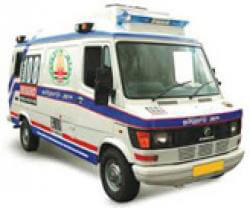
Claim 95% Heart Attack Victims Dont Use Ambulance,Increasing Risk Of Death
Chennai: About 95% of Indians who suffer a heart attack dont use an ambulance to reach a hospital,resulting in many deaths that can be avoided, say cardiologists.Participants at the STEMI India conference on advanced cardiovascular therapeutics here on Friday said most of them took private vehicles to go to hospital. An ambulance has paramedics to provide first-aid.This would cut the mortality rate by 50%.But not many people understand this.Immense amount of public education is needed on using the ambulance services, said Dr Matthew Samuel K,a course director with ST...

STEMI India to focus on developing system of care for ST-elevation myocardial infarction
STEMI India, a not-for-profit national organization, is now focused on improving the ST-elevation myocardial infarction (Stemi), a life threatening medical emergency that results from a sudden and occlusive thrombus in the coronary artery in India.
The NGO is now gearing up to review scientific literature, educate and train Stemi teams in hospitals, develop Stemi guidelines and systems of care approaches relevant for India.
It has also released a data from CREATE, a large clinical registry of acute coronary syndrome patients from 89 large hospitals in 10 regions and cities across India conducted by the Kovai Erode Pilot which is a Stemi initiative.

2013 Consensus Statement for Early Reperfusion and Pharmaco-invasive Approach in Patients Presenting with Chest Pain Diagnosed as STEMI (ST elevation myocardial infarction) in an Indian Setting
Abstract In India, the prevalence of ST elevation myocardial infarction (STEMI) is rising exponentially leading to cardiovascular morbidity and mortality. Despite advancement in reperfusion therapy (pharmacologic and interventional), the overall utilization, system of care and timely reperfusion remains suboptimal. Justification and Purpose: Alarming treatment delays exist in patients presenting with chest pain observed in real-world and published evidences. Time to diagnose STEMI and initiation of reperfusion therapy at various first medical contacts in India is variable mandating immediate attention. We intend to provide evidence based explicit recommendations for practicing clinicia...
Pilot program in Tamil Nadu focuses on acute care of ST-elevation myocardial infarction.
A treatment plan for the acute care of ST elevation myocardial infarction (STEMI) has been launched within a large rural district of Tamil Nadu, India. Taking advantage of recent changes, such as the GVK EMRI ambulance system and the government insurance program in Tamil Nadu, the program's early data demonstrate an improvement in the quality of acute STEMI care by dramatically decreasing the time from symptom onset to hospital arrival and subsequent receipt of percutaneous coronary intervention (PCI). "This is a pilot project funded by the Indian Council of Medical Research to develop a system of care that could be a model for an eventual STEMI system of care in In...

Systems of care for ST-elevation myocardial infarction in India
The prevalence of coronary artery disease and STelevation myocardial infarction (STEMI) are increasing in India. Although recent publications have focused on improving preventive measures in developing countries, less attention has been placed on the acute management of STEMI. Recent policy changes in India have provided new opportunities to address existing barriers but require greater investment and support in the coming years. Coronary artery disease (CAD) is currently the most common, non-infectious disease in India and will affect over 65 million of its people by the year 2015 ...

Need a title
COIMBATORE: A recently formed national body of interventional cardiologists will look at forming a quick reaction network of hospitals and ambulance service providers in Tamil Nadu to save persons who have suffered a heart attack. The effort is to enable quick shifting of patients to hospitals for life-saving treatment. ST (a segment) elevation in myocardial infarction (STEMI) or heart attack is one of the leading causes of death in the world, says Chief Cardiologist at Kovai Medical Center and Hospital (KMCH) Thomas Alexander, one of the heart specialists pushing hard for the project. STEMI India, the new national-level body, may contempla...

Framework for a National STEMI Program: Consensus document developed by STEMI India, Cardiological Society of India and Association Physicians of India
The health care burden of ST elevation myocardial infarction (STEMI) in India is enormous. Yet, many patients with STEMI can seldom avail timely and evidence based reperfusion treatments. This gap in care is a result of financial barriers, limited healthcare infrastructure, poor knowledge and accessibility of acute medical services for a majority of the population. Addressing some of these issues, STEMI India, a not-for-profit organization, Cardiological Society of India (CSI) and Association Physicians of India (API) have developed a protocol of ‘‘systems of care’’ for efficient management of STEMI, with integrated networks of facilities. Leveraging newly-devel...